
 Written by
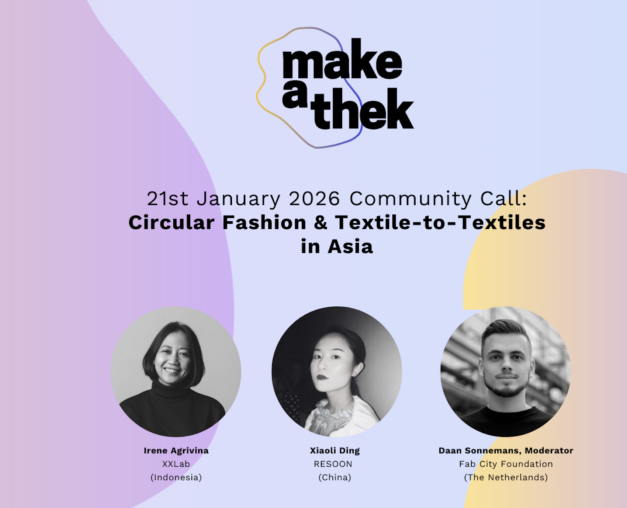
 Global Innovation Gathering and Fab City Foundation held a community call on January 21, 2026, focused on circularity in Asian textiles and fashion. The session was part of the make-a-thek project, funded by the European Horizon Europe programme. This project establishes maker spaces in libraries across Europe, connecting local initiatives to global sustainability goals and promoting sustainable fashion. By aligning with planetary boundaries, make-a-thek emphasizes balancing ecological sustainability with social equity, mapping European innovation onto the Doughnut model for a safe and just society.
Daan Sonnemans, project coordinator at Fab City Foundation, moderated the session. The Foundation advances the shift from linear to circular economies by supporting local solutions and fostering global connections.
Irene Agrivina introduced XXLab, a women-led collective in Yogyakarta, Indonesia. Driven by environmental concerns and the need to address pollution, she founded XXLab to merge sustainable science with community-driven projects. The collaborative workspace enables women to conduct open-source research at the intersection of science and technology.
XXLab manages Soya C(o)u(l)ture, a ten-year project that converts wastewater from tofu production into biomaterials. In Indonesia, waste from the tofu and tempe industries often pollutes rivers.
The project uses fermentation to produce cellulose, which acts as a ‘technical nutrient’ in a cradle-to-cradle cycle, enabling continuous reuse. XXLab shares research and recipes on open-source platforms to encourage community adoption and create income opportunities for women in rural areas.
Xiaoli Ding introduced RESOON, an organization in Shenzhen, China, dedicated to transforming waste into resources through closed-loop ecosystems.
China produces 26 million tons of textile waste each year, enough to fill 2.6 million garbage trucks. With a recycling rate of only 1%, RESOON addresses this challenge by connecting supply and service nodes and prioritizing data movement instead of shipping waste overseas.
RESOON’s model features a three-layer flywheel: product, service, and community. The product layer grades waste from factory deadstock to low-durability materials. The service layer provides repair and care through a network of tailors. RESOON rewards participation with a carbon points system, allowing users to earn points for purchases or workshop attendance. The organization also develops product passports to track fiber data throughout the lifecycle. Transforming waste into resources requires navigating regulations and permissions, and government agendas often differ from grassroots innovation. RESOON uses standards to support green transitions in factories.
Participants discussed applying these techniques in other contexts. In Tanzania, there is interest in using seaweed and sisal for textiles. In South Sudan, limited electricity restricts the use of sewing machines. Community members suggested pedal-powered machines to address energy constraints, demonstrating creative resilience and context-sensitive solutions. The discussion encouraged further ideas for low-tech innovations in areas with limited electricity, viewing constraints as catalysts for design.
The call concluded with a request for action. Individuals are encouraged to adopt toolkits or organize workshops in innovation hubs, following the main motto that “Designers can use open-source patterns to create products from waste”.