
 Written by
 Air pollution and climate change remain urgent global challenges, yet many cities lack the environmental data needed to act. While major developed cities may have regular air-quality monitoring, many countries, especially across Africa, rely on only a handful of sensors to represent millions of residents. Meanwhile, cycling, often framed as an inexpensive solution to urban pollution, remains far from simple for many urbanites. Safe cycling lanes are often missing, roads are uneven, and collisions with motor vehicles continue to rise.
These realities highlight a deep need for cities to become safer, healthier, and more responsive to the people who move through them daily. However, without adequate data on both air quality and cycling conditions, local solutions often stall. Amid this urgency, a new innovative idea is emerging: what if everyday cyclists could turn their rides into powerful acts of citizen science, generating the missing data that could help reshape urban sustainability and safety?
The senseBox:bike
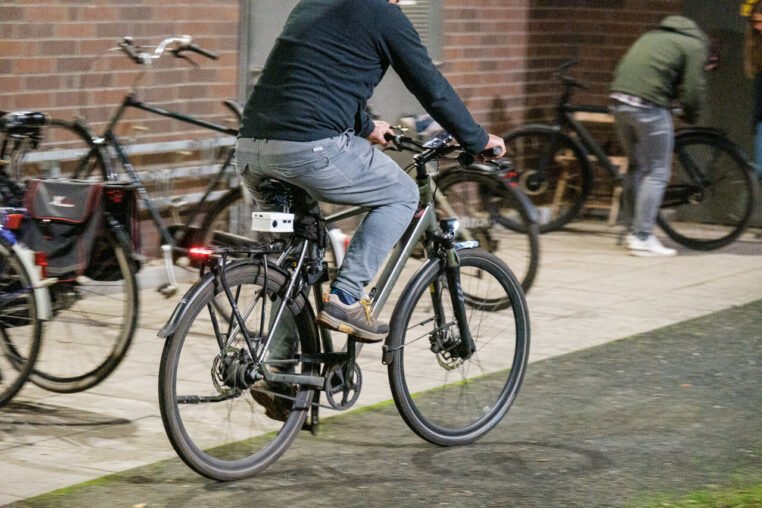
At the intersection of mobility justice, air quality, and citizen science sits the senseBox:Bike. Created by Münster-based GIG Hub re:edu, the senseBox:Bike is a citizen-operated device for collecting data about environment data and urban cycling conditions. Motivated by a need to better understand cycling conditions in cities, this open-source kit turns any bicycle into a rolling environmental observatory, inviting citizens to measure, map, and make sense of their own cities.
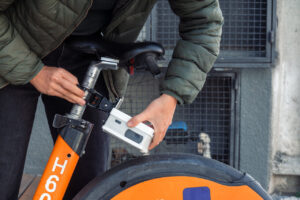
Simple to mount and remove, the senseBox:Bike tracks passing distances from vehicles, road conditions, speed, and standing time, capturing the subtle cues that shape how safe a ride feels. At the same time, it measures key environmental indicators like particulate matter, temperature, and humidity, allowing riders to see their surroundings through an entirely new lens. The device’s 3D-printed housing is designed for durability and accurate sensing, with built-in ventilation to protect measurements from heat distortions. With on-device machine learning that detects overtaking maneuvers and reads road quality in real time, the senseBox:Bike does not just collect data, it interprets it, empowering cyclists with actionable insight and the ability to influence public policies aimed at improving cycling infrastructure.
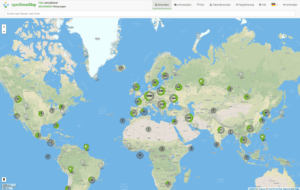
All collected cycling data connects to openSenseMap, where cyclists visualize routes and share findings with researchers, activists, and city planners around the world. Additionally, GIG member Artur Kim Shum works with the re:edu team on Atrai Bikes, a Brazil-Germany joint project funded by BMFTR and FAPESP. In this project, a data platform is provided where local citizen-led campaigns can be visualized and combined with additional data sources, helping cities integrate citizen-generated evidence into their planning processes.
What then begins as a simple bike ride becomes part of a collective effort to expose mobility gaps, reveal pollution hotspots, and advocate for more sustainable, equitable urban design.
Development of the senseBox:bike
The first prototypes of the senseBox:bike were co-designed during a makeathon in February 2021, organized with Futurium Berlin, the Stuttgart State Academy of Art and Design, and the c.lab of Munich University of Applied Sciences. Further prototyping then followed in October 2021, when Futurium Berlin hosted a hands-on workshop where participants assembled and mounted senseBox:bike devices on their own bicycles and set out across Berlin to collect some of the first ever mobile environmental data generated directly by cyclists. These measurements were later featured in a Futurium exhibition, visualizing Berlin’s air quality, noise, and road conditions from cyclists’ perspectives.
Beyond Berlin, diverse stakeholders have tested the senseBox:bike in workshops and educational-maker programs in other cities, such as Münster and Essen, Germany, and São Paulo, Brazil. These stakeholders range from students and technical teams to delivery riders, commuters, and activists.
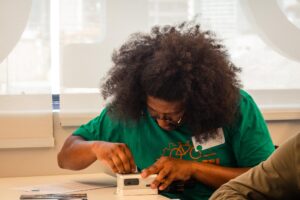
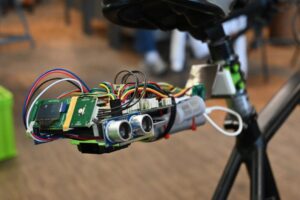
Stakeholder feedback has sparked significant improvements of the device’s design, which has since evolved from heavy iron mounting plates to lighter 3D-printed housing, with refined internal components and better ventilation for stable readings. The team has also prioritized making data visible and understandable to keep users engaged using an APP (sensebox:bike), alongside strong documentation to enable wider adoption. These factors help to connect data to user experiences, revealing real mobility challenges that inform better urban policies.
Today, the senseBox:bike is finding a home in community-oriented initiatives across Germany. Students in Essen use it to assess school cycling infrastructure through the Essen auf Rädern initiative, and municipalities in Münster and Osnabrück have access to rich data sets to evaluate local mobility patterns through the IIP project.
Cycling Forward
Beyond its technical potential, the senseBox:bike is becoming a vehicle for environmental education and empowerment. By bringing sensing tools to young people, schools, and neighbourhood groups, it encourages citizens to become active contributors to open knowledge and global environmental commons. What emerged from collaborative prototyping has evolved into a powerful tool for participatory urbanism.
The vision for the future is clear for the re:edu team: expanding the senseBox:bike to more cities, strengthening the data platform, and enabling municipalities and communities to make better, evidence-based decisions for sustainable urban mobility. Cities can tailor data collection to local challenges, from mapping heat islands to assessing cycling safety. As an open-source project, it allows an ever-growing set of sensors and modules to be added, enabling full customization to local needs.
The project has also started a new user case with EU-funded Lauds Factories project, in partnership with other GIG Member Laura Sobral and local municipalities in France, University of Lorraine, and Lorraine Smart Cities Living Lab (LSCLL), to co-develop advocacy strategies using data collected by citizens and the senseBox:bike
The road is wide open for the senseBox:bike as it continues to embody the spirit of the broader global citizen science movement: technology in the hands of people, knowledge shared in the commons, and data used to advocate for safer and more sustainable cities.
Stay updated on the environmental monitoring projects that the GIG community is working on – Sign up for our newsletter here.