 Written by
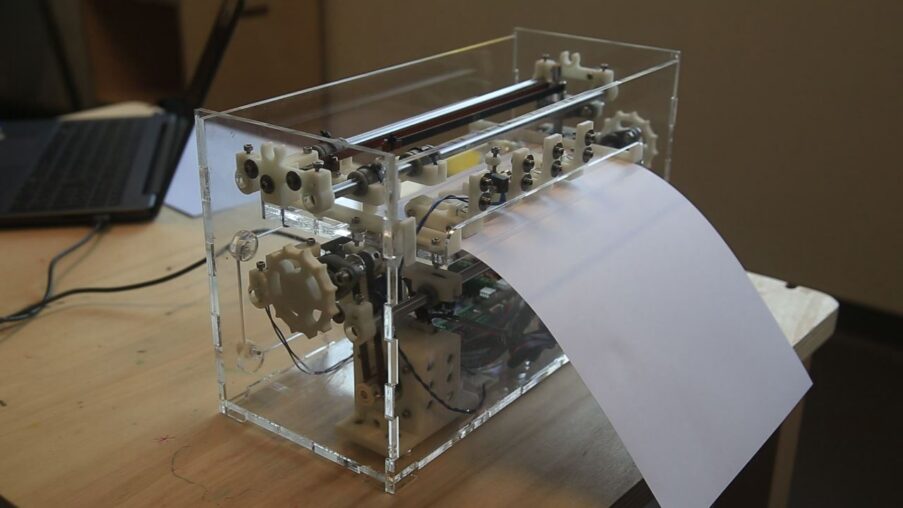
 Somewhere in a library in Punggol, Singapore, a machine the size of a small suitcase is pressing dots into a sheet of aluminium — dots that a blind person can read. The machine did not come from a manufacturer. It was built from 3D-printed parts, stepper motors, and a solenoid, following instructions available for free download. The person who built it is Saad Chinoy, co-founder of SalvageGarden and a founder member of the GIG community. Behind that machine is a story about open-source collaboration spanning continents, and about what happens when makers decide that accessibility tools should be buildable by anyone, anywhere.
SalvageGarden is a volunteer-led assistive technology makerspace in Singapore, founded in 2020 by Saad and LJ Jang. Operating from the Punggol Regional Library, it runs weekly “Critical Making” design sessions that bring together people with disabilities, caregivers, makers, designers, and clinicians in a collaborative environment where 3D printers are used for hands-on prototyping. The model is participatory by design: co-creation with the people who will actually use the devices, not delivery to them. Saad spoke about this directly in an interview with The Straits Times. “The tried-and-tested formula of treating beneficiaries as recipients in the social service space,” he said, “wasn’t really working.”
The device at the centre of this story is BrailleRap — an open-source Braille embosser that presses dots into material rather than depositing ink, producing text a reader can feel with their fingertips. Unlike commercial alternatives, which can cost upwards of US$2,500, BrailleRap can be built for around US$350 using 3D-printed parts and off-the-shelf components, following a freely available manual. The project was started in 2018 by two French makers from the FabLab community and is licensed under CERN-OHL-P V2.0 — meaning anyone can build it, adapt it, and even sell it. What makes it unusual is not just the price gap. It is the only open-source Braille embosser you can actually replicate yourself, step by step, from a manual.
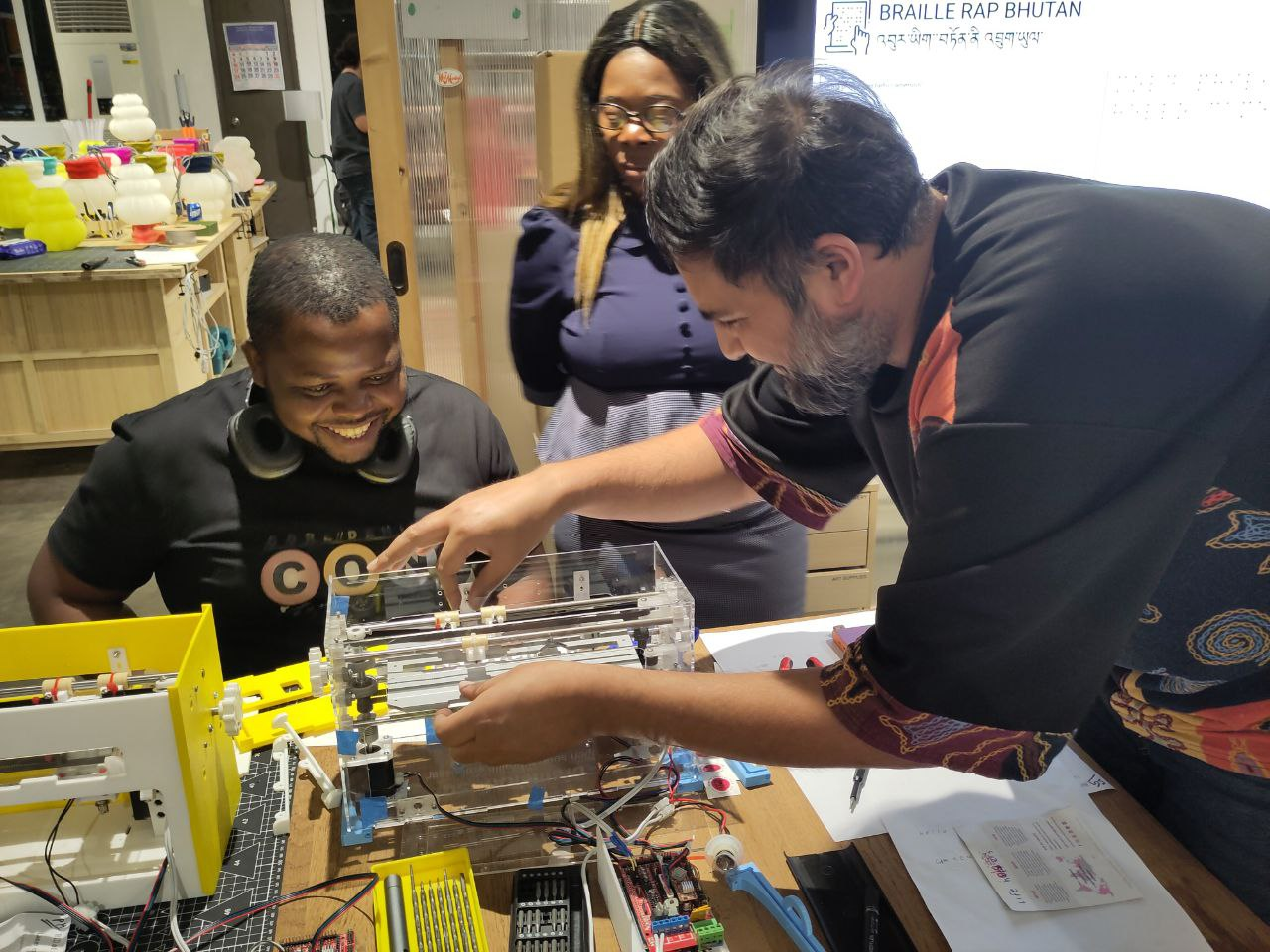
Saad’s path to BrailleRap runs through Bhutan. In 2023, he participated in Fab23 in Bhutan, the global Fab Lab gathering, where he encountered staff and students from FabLabCST — the Fab Lab at the College of Science and Technology in Phuentsholing. They were working on two things that seemed unrelated: aluminium recycling from drink cans, and support for students with visual impairments. BrailleRap, it turned out, connected both.
In Saad’s words: “Fab23 Bhutan was the inspiration, working with FabLabCST staff and students who work to address aluminium recycling while also being responsible for helping people with disabilities. BrailleRap was found to make sense to both these seemingly unrelated issues. The open source nature of the project allowed for Braille to be embossed on aluminium sheets made from recycled drink cans.”
That insight — that the same machine could close both a material loop and an accessibility gap — is the kind of lateral problem-solving that open hardware enables and that institutional procurement rarely reaches. The Bhutan build was documented and presented at re:publica 2024 in Berlin, where Saad joined GIG network member Felipe Schmidt Fonseca for a session titled “BrailleRap Bhutan: how we replicated an open-source braille printer and so can you”. The session examined how the creative problem-solving process of replicating an open-source hardware project offers meaningful learning opportunities — from the FabLab on campus to the broader context of a country at the end of a long supply chain. Saad went on to bring BrailleRap to BuildPeace 2024 in Manila, FabCity Hamburg, FOSSASIA 2025, and Dinacon Bali. At each stop, the goal was the same: to demonstrate that building the machine is itself the knowledge transfer, not a prelude to it. Each build is an occasion for local makers, disability practitioners, and community members to work together through the same process. Each build is an occasion for local makers, disability practitioners, and community members to work together through the same process.
Saad returned from Bhutan with more than documentation. Back in Singapore, he built BrailleRap SG, the first device in the country, at SalvageGarden, and is now working on the third machine. The work sits inside SalvageGarden’s wider portfolio of open-source assistive devices, which includes 3D-printed prosthetic hands, one-handed kitchen tools, coin-discrimination aids, wearable caption devices for deaf theatre audiences, and tactile board games. SalvageGarden has previously built a wearable caption device made entirely from 3D-printed parts and a Raspberry Pi for a theatre company’s walk-about show, allowing deaf and hard-of-hearing audience members to follow actors as they moved through multiple locations in Singapore’s Civic District.
The devices are documented and shared. Saad’s 3D model collections are published on Printables and Cults3D. The full SalvageGarden assistive tech directory is maintained at salvagegarden.notion.site. For BrailleRap specifically, the building manual, firmware (based on Marlin), STL files for 3D-printed parts, and translation software are available via the main BrailleRap GitHub repository. The text-to-Braille translation software — AccessBrailleRAP and DesktopBrailleRAP — connects to LibLouis for Braille translation and supports embossing both text and vector graphics, including tactile maps extracted from OpenStreetMap.
The social dimension of the work is something Saad is direct about: “The social effect of engaging technical and engineering people to work with practitioners, families, and people with disabilities is remarkably tangible through the co-creating process of replicating open source hardware.” This is not a peripheral benefit of the build process — it is the point. Replication is not just production; it is the infrastructure for a different kind of relationship between makers and the communities they work with. Since its inception, SalvageGarden has mobilised over 65 volunteers to build an ecosystem for accessible, open-source, locally manufactured assistive technology, and has expanded its Make Inclusive Tech (MIT) Sundays workshops to three new locations across Singapore in partnership with SG Enable’s i’mable programme.
What Saad is doing with BrailleRap is not a pilot project waiting for institutional backing to scale. It is already scaling through the logic of open hardware itself: each build produces documentation, each documentation enables the next builder, and each builder adds a community of practitioners to the network. GIG has seen this pattern before — in repair cafés, in community Fab Labs, in open medical device projects during the pandemic. What is specific here is the intersection of accessibility, circular material use, and maker practice in a context where commercial assistive technology remains expensive and supply chains are long.
We are glad to have Saad as part of the GIG network, and glad that his work spreads — not because anyone is managing its diffusion, but because the files are there and anyone can build on them. Somewhere right now, in a library or a workshop or a school, someone may be reading those files and deciding to build. And when they do, another machine will begin pressing dots into metal — dots that someone, somewhere, will read.
Build it yourself: BrailleRap building documentation · AccessBrailleRAP translation software · SalvageGarden device library · BrailleRap Singapore hub