
 Written by
 At eight in the morning in Santiago, it was already seven in the evening in Manila. Accra and Cape Town sat somewhere in between, Berlin was having a late lunch, and in Yogyakarta a whole team had stayed up past dark to be on the call. That was the clock behind the make-a-thek Global Pilots kick-off on 1 October: the first time the five pilots outside Europe met each other, and met the library teams who have spent two years building the first nine.
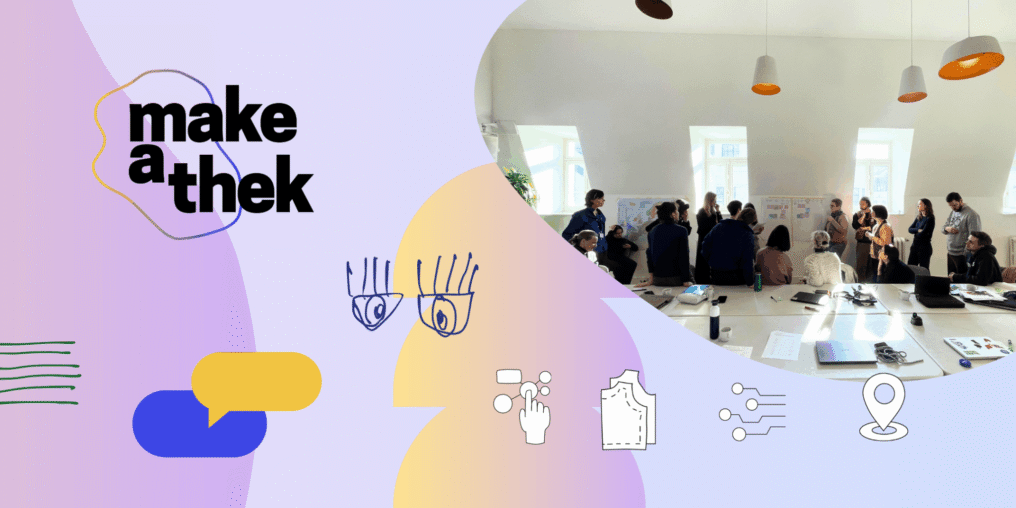
make-a-thek is an EU-funded project that turns public libraries into community makerspaces for circular fashion, repair, crafts and heritage. GIG is one of the consortium partners, together with Public Libraries 2030, Fab City Foundation, OpenDot Foundation and Fashion Revolution Germany. The global pilots are the part of the project we have been most curious about: what happens when the idea leaves Europe, and meets the places where Europe’s discarded clothes end up?
The session ran well over its planned time. Nobody seemed to mind.
Where the European pilots stand
Ilona Kish of Public Libraries 2030 opened with a recap. The project runs for three years and is now ending its second. Nine pilot cities are active, plus two in Ukraine, in Kyiv and Zaporizhzhia, where libraries opened their spaces despite lockdowns and attacks on branches.
The numbers she shared are small and human. A bus tour through the Baltic States reached ten cities in two weeks and met more than 450 people, from teenagers touching a sewing machine for the first time to older people who had sewn all their lives. The new space in Barcelona has been fully booked since the day it opened. Milan was opening within days, with a 3D textile printer on order. Antwerp built its space together with a diverse youth team, in a part of the city with real social and economic pressure.
Emma from Budapest Central Library added what the first months taught them: leftover and unused materials draw in people who would never walk into a makerspace, and a quick, lively format works for teenagers while a calmer one works for older visitors. Their permanent makerspace opened in April, and the schedule is already full.
Ilona also named the uncomfortable part. Fast fashion is a Western habit, and when we are done with the clothes we ship them back to other parts of the globe. The five global pilots start from that other end of the same garment.
Five pilots, ten minutes each
Each global pilot had ten minutes. None of them fit, and that was clear within the first presentation.
Philippines
Rosanna Lopez of GIG and Sparkle Lab opened with a jeepney: the drivers who pour water into a radiator through a bottle while still driving passengers around Metro Manila. After Typhoon Haiyan, she reminded us, hospitals without power used plastic soda bottles for manual resuscitation. Repair and improvisation are not a trend there; they are what people do when systems fail. With Fashion Revolution Philippines, the pilot will be built on that culture, with clear rules about respecting indigenous textiles and asking permission before using them.
The workshop ideas are wonderful: adaptive clothing with the disability community, a fashion show of abaca, banana and pineapple fibres that doubles as a fundraiser, and a waterproof “Bagyo go bag” made from recycled tarpaulin for typhoon season. A library in San Juan, Pasig or Quezon City should be confirmed within two weeks, with a hard launch planned for the national library month in November.
Indonesia
The Yogyakarta team did not come to build one big makerspace. Their starting point, in the words of the presenter, is “connecting what is already here”: makers, repair communities, researchers and grassroots technology groups that already exist in the city. HONF coordinates a network of local nodes, including GIK UGM, a creative hub at Universitas Gadjah Mada with a 5,000 m² site, AK Circular Studio for mending, dyeing and upcycling, Meet the Makers Indonesia for traditional artisans from across the archipelago, and Repair Cafe Yogyakarta, which turns a cafe into a repair shop where you can drink coffee while your broken things get fixed.
The timeline is clear: ecosystem mapping now, kick-off workshops from October to February, and the main programme from February to April.
South Africa
Safiyya Karim of Fashion Revolution South Africa described a country where textiles once thrived, and where sewing and craft are no longer taught in school, so skills stop travelling between generations. Libraries are close to public transport, which makes them one of the few accessible places to learn. Flippie van der Walt from the City of Cape Town Library Services told us the city runs 101 public libraries, many with sewing, knitting and crochet clubs, and is planning a 102nd that will be the first public library in South Africa with a dedicated makerspace.
The partnership launches during a festival at Cape Town Central Library around International Repair Day on Saturday 17 October. Other pieces are already moving: a natural dye workshop with an indigenous shrub, a permanent textile makerspace run by Fashion Revolution South Africa, and a design lab at the University of Cape Town working on accessibility, including wheelchair ramps repaired and built by volunteers who earn vouchers for food and airtime.
Ghana
Joseph Agyina of Makerspaces Africa and Samuel Duah introduced a pilot that wants to solve two problems at once: libraries that are emptying out, and about 15 million secondhand garments arriving in Ghana every week, around 40% of which are already waste. Accra Central Library will host the work in its youth centre for innovation, together with Hapa Space in Kumasi, Reclaimed Textiles Network Ghana and Upcycle It Ghana.
Dr Christiana Okai-Mensah explained why the offcuts matter: they end up in gutters, and the gutters flood Accra. Her network trains students to turn them into pillows, bags, dresses and fascinators, then invites policymakers to see the results. Makerspaces Africa will use the pilot to draft a policy that brings makerspaces, repair and sustainable fashion into libraries and other public spaces.
Chile
Barbara Velasco, who coordinates the Chilean pilot, described three territories and three different approaches. In La Serena, the Gabriela Mistral Regional Library already has an active cultural community, and the pilot gives it new tools and a semi-permanent space for sewing, repair and textile printing. In Valparaíso, the historic Santiago Severín Library connects collective reading with textile creation, with a focus on women facing unemployment. In Santiago, the Fab Lab at the University of Chile expands its Reparatón festival into textile repair, including an open-source drone built from textile waste.
“Three contexts, three approaches, and one shared purpose,” Barbara said. Representatives of Chile’s National Public Library System joined as well, and the Ministry of Cultures’ craft area is part of the work.
Questions, a group photo and what comes next
Joseph asked the Philippine team how they plan to keep a library makerspace funded over time, because Accra Central Library will need an answer too. Rosanna’s ideas were practical: the fashion show as a fundraiser, an invitation for participants to leave one of their upcycled pieces in the library for others, and corporate sponsors whose sustainability goals fit the project.
Sandra Mamitzsch of GIG pointed to something the original proposal did not plan for. We imagined one partner per pilot country. What we got instead is a bottom-up process in which many organisations (libraries, universities, repair groups, designers, artisans, ministries) build one plan together for their cities and the regions around them. Then everyone opened their cameras and held up something small from their desks for a screenshot, because online meetings do not allow a proper group photo.
Flippie van der Walt wrote in the chat that empowering people through makerspaces is “bold and worthy to all.” Ambar Kusuma of AK Circular Studio wrote that she was proud to be part of the pilot.
Next steps
- Digital toolkit onboarding with OpenDot Foundation, covering how to start a material library, set up a space and more. The toolkit is at makeathek-toolkit.eu, and a poll is open to choose session times.
- Communication onboarding with Fashion Revolution Germany.
- International Repair Day on 17 October, with events across the European and global pilots.
- A monthly check-in call, rotating its time so that Latin America and Southeast Asia take turns with the early mornings and late nights.
- Country sessions where each pilot gets more than ten minutes to tell its story.
To follow along, find make-a-thek on Instagram, LinkedIn, Facebook and in the newsletter. Tell your friends.
Ilona Kish ended with a question she said she is very curious about. Libraries in Europe function in a certain way we recognise. Is library DNA global? After this call, we think the answer will be: partly, and the differences are where the learning is.