
 Written by
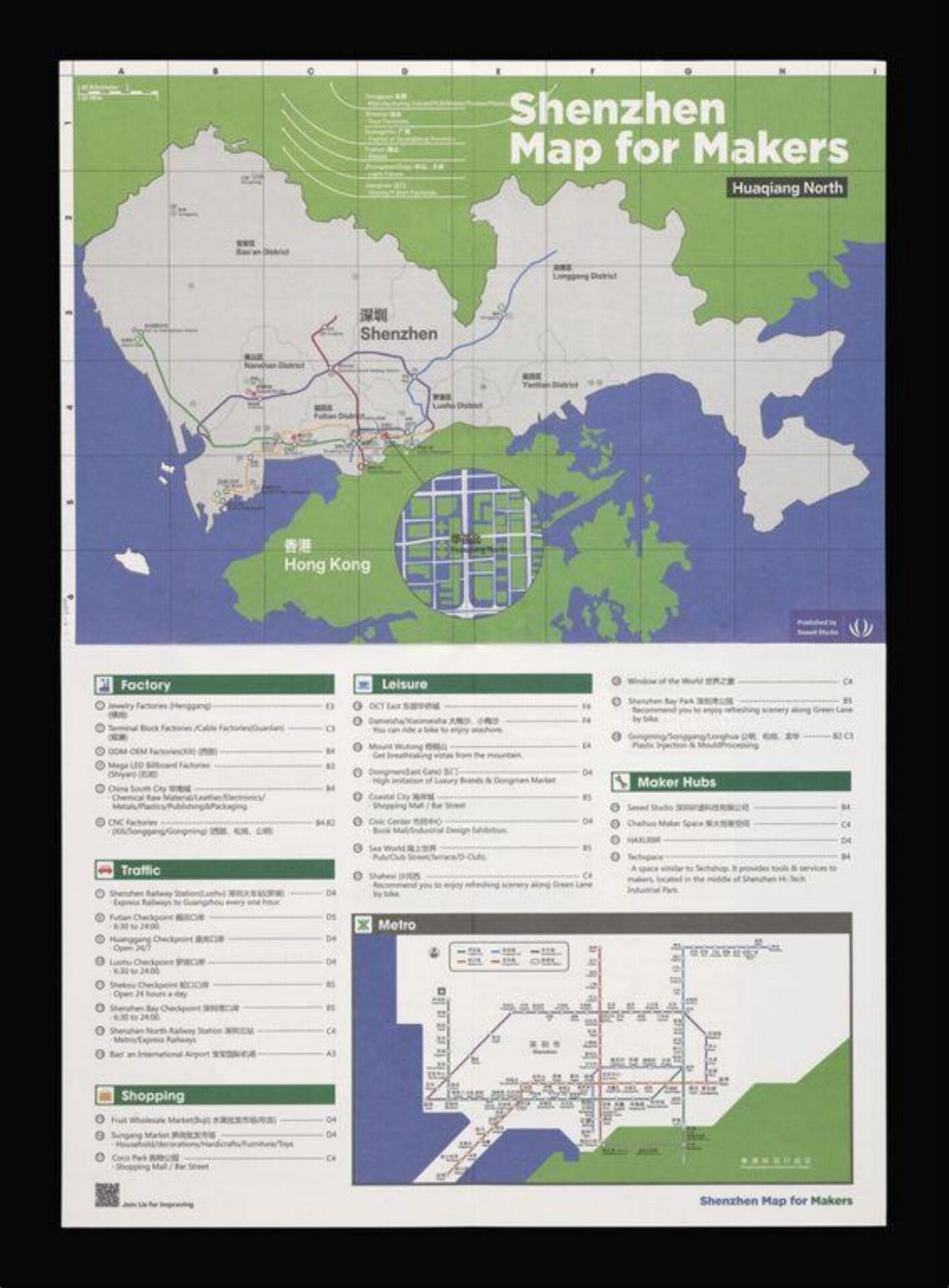
 In 2013, a team from Seeed Studio spent three months walking through Huaqiangbei, the electronics market of Shenzhen. They made several field trips to the market to search for resources, took pictures, and designed and redesigned until the map was ready. The result was the Shenzhen Map for Makers. The PDF was free to download, and the printed version cost five dollars, the same as the cost of producing it. The map was also open source, with a wiki page so anyone could update it. Today a copy is in the V&A collection in London. We start with this map because it tells us how Seeed works. Before selling us hardware, they drew where hardware comes from, and they asked the community to keep drawing.
Seeed Studio as a hub
Since 2008 Seeed Studio has served the developer community through open technology and agile manufacturing, guided by a mission to lower the threshold for hardware innovation. Their own About page puts it in three words: making technology accessible. Since 2011 Seeed has powered Chaihuo Makerspace, the first makerspace in Shenzhen and a community hub for makers who prototype for sustainability and digitalisation. The Chaihuo community also organises Maker Faire Shenzhen, and each year Seeed invites makers from around the world to explore Shenzhen’s tech ecosystem through Maker Camp.
So while Seeed might be a company with a store, distributors and factories, it is also a community hub, making it a wonderful member within the GIG network.
Hardware that senses
Then there is the hardware produced by Seeed Studio itself. This includes its XIAO development boards that are the size of a thumb, its Grove sensor modules that plug and play without soldering, and the Wio Terminal, a compact programmable device with a built-in screen and wireless connectivity. Behind these products, Seeed Fusion takes a design and returns circuit boards, assembled units and 3D printed parts. It has brought community projects like the OpenUC2 AI Microscope and the Smart Citizen Kit 2.3 to market. This helps maker projects get past the scalability barrier that most grassroots initiatives hit.
What connects Seeed to so many of our grassroots members is sensing the world. The SenseCAP family measures air, soil, light, wind and rain, and is designed to stay outdoors for years. For example, the SenseCAP S2120 collects air temperature, humidity, wind speed and direction, rainfall, light, UV index and barometric pressure, and sends it all over LoRaWAN (a low-power radio technology that carries small amounts of data over long distances). Put simply, a community with no weather station, unstable internet and few technicians can still measure its own air, soil and rain.
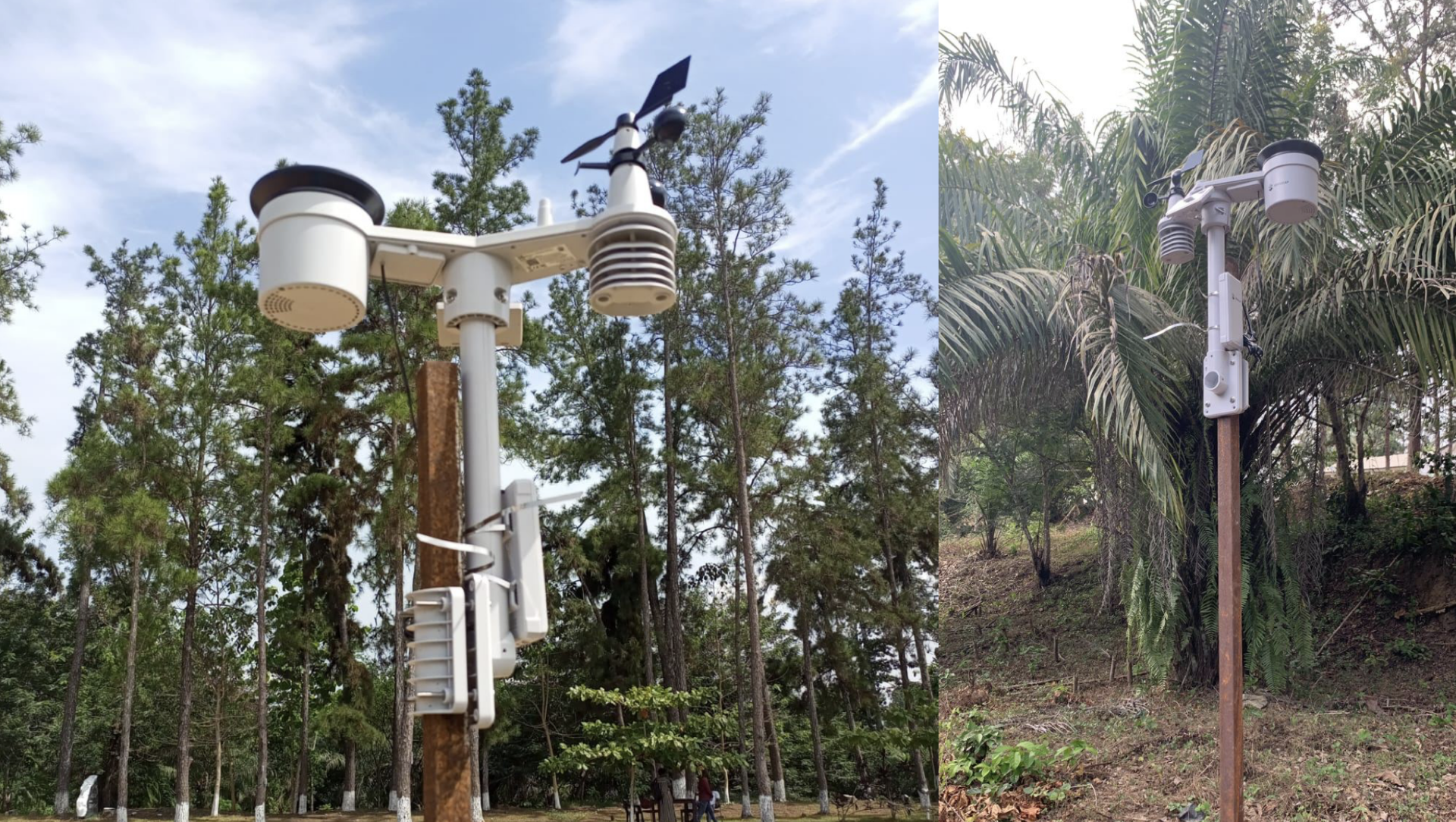
In Bomi County, Liberia, for example, the Forestry Training Institute partnered with One Planet Education Network (OPEN) and the University of Maryland to deploy greenhouse gas sensors and weather stations in a rainforest outdoor laboratory next to the campus. Liberia’s forests make up more than half of the remaining rainforests in West Africa, yet the country lost 100,000 hectares of natural forest in 2021. The project uses SenseCAP S2103 CO2, temperature and humidity sensors, the S2120 weather station, and a SenseCAP M1 gateway to collect real-time CO2 data while forestry students use the site as a living laboratory. SenseCAP sensors have also helped OPEN to measure the carbon sequestration of soils and surrounding ecosystems in Bungoma, Kenya, so farmers can adapt to climate change. Read the full case study.
Of course, the hardware is only one half of the equation. A sensor alone does not protect a forest, and data sitting on a server on another continent does not help a local farmer unless someone there can read it, question it and decide what to do with it. The other important half is the people in the hub. Seeed’s Ranger Program has community members leading workshops and events in their own cities. In 2025, 18 Rangers led and joined more than 40 events and brought together over 3,000 participants, from tinyML (machine learning on very small, low-power chips) workshops in Indonesia to the IoT community in Medellín. They recently launched the Ranger Program 3.0 in January 2026, where Rangers act as local technical partners, bridging tech and local industries.
Seeed Studio & GIG Fund Partnership
Everything above is why we are thrilled to announce that Seeed Studio is now an official community hardware sponsor of the GIG Fund, our recent participatory fund for grassroots innovators building resilient, inclusive and adaptive urban areas. This Sponsorship Program offers 25 grants in total: 20 Seed Grants of $500 and 5 Scale Grants of $2,000, adding up to $20,000 in hardware and manufacturing support for the development of grassroots innovations projects.
This partnership is a chance to foster solidarity between hardware manufacturers like Seeed and makers all around the world. GIG members run makerspaces, fablabs and hubs in places where components are expensive, shipping is slow and customs are an ordeal, and Seeed has the factories, the stock and the manufacturing know-how to help close that gap between idea and implementation.
Grants come as coupon codes for the Seeed store, and can be spent on products like SenseCAP sensors, XIAO boards, reCamera and LoRaWAN gateways, or on Fusion services such as circuit board prototyping, fully assembled boards and 3D printing. To better support the GIG community, Seeed will also host a community call for GIG members to present the program and answer questions and offer training and technical consultations to grantees.
How to apply as a GIG member
Applications close on 20 October 2026, so there is little time left. You can apply if you are a GIG Fund 2026 grantee, a shortlisted GIG Fund 2026 applicant, or a project recommended by a GIG core member. Projects from the Global Majority countries are especially welcome, as are projects working on energy equity, circular economy, education equity, digital inclusion, and wildlife and ecology conservation.
Your application needs:
- A project summary of up to 500 words
- A hardware needs statement
- A bill of materials generated with [Seeed CodeCraft, link]
- Your tier preference (Seed Grant or Scale Grant)
Submit everything through this application form. GIG will screen applications and recommend projects, and Seeed will then make the final selection. Results will be announced on the GIG Discourse thread, our members’ online forum, in early to mid-November. If you have questions, post them on the thread or write to [email protected].
Top projects may be invited to showcase at Shenzhen Maker Faire, happening on 12 and 13 December 2026.
What comes next
This first sponsorship cycle is just the start. If all goes well, we aspire for hardware support to become part of every GIG Fund cycle. To foster more meaningful collaborations, we hope to bring GIG members to the annual Maker Faire Shenzhen, open the Ranger program to GIG makers who already do this work in their cities, and to welcome Seeed to GIG Week, our event in Berlin every May.
And here is our call to every GIG member: continue sensing the world. Build a weather station on the roof of your makerspace. Put a CO2 sensor in the classroom where you run workshops. Plug a soil sensor into the community garden next door. A XIAO board with a few Grove modules is enough to start teaching, and a SenseCAP station with a gateway can cover an entire neighbourhood. The Seeed Wiki is open, the projects on Hackster are documented, and our Discourse is there for all of us to share what worked and what broke. Imagine a map of the GIG network where each dot is a hub reading its own air, water and soil, and publishing it openly. Now, isn’t that a map worth drawing together?
In 2013, Seeed drew a map of one market in one city and asked others to finish it. Thirteen years later, the map is the world, and we are all invited to keep drawing.
Follow Seeed Studio and their community on LinkedIn, X, Instagram, Facebook, YouTube, Discord and Hackster.