
 Written by
 Zuzana Šmrkovská’s knitting machine is from the 1980s. It’s a Brother, one of the 900 or 950 series, the kind that used to hum through Czechoslovak textile factories before that whole industry collapsed. She runs it now from her laptop, through an open source controller built by the AYAB community. Same machine, different century.
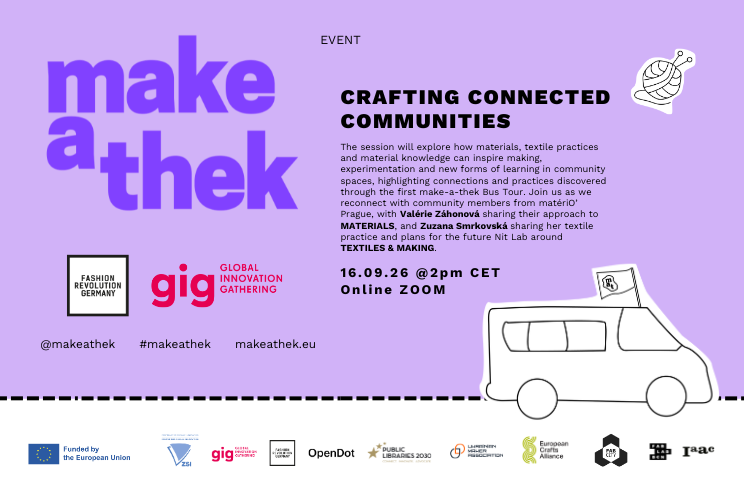
That image opened our latest make-a-thek community call, Crafting Connected Communities, co-hosted with Fashion Revolution on 16 September. The session picked up threads (literally, in this case) from our first make-a-thek Bus Tourthrough Germany, Czechia and Poland in June, bringing some of what we learned on the road back to the wider network. Carina Bischof hosted from GIG/Fashion Revolution, and people logged on from Berlin, Barcelona, Munich, Leipzig, Cape Town and Prague itself to hear two practitioners talk about materials, craft, and what actually keeps a community coming back to make things with their hands.
A library you can touch
Our first guest, Valérie Záhonová, is a material consultant at matériO’ Prague, the local branch of a network that started in Paris in 2000 and now also has outposts in Seoul and Geneva. The idea, she said, sits on three words: inspiration, innovation, independence. Independence matters most to them. matériO doesn’t take money from the manufacturers whose materials sit on its shelves.
The Prague branch has been open since 2011, in Břevnov, and holds around 3,000 physical samples: not just textiles, but wood, paper, plastics too. Some of them are strange in the best way. Tiles grown by bacteria into something like limestone. What Valérie called the lightest fabric in the world. Lenticular 3D prints on cloth. A team of four consultants, from architecture, design, textiles and art, runs the space on a membership model, open by appointment, and stays busy with workshops, custom research, and a long-running partnership with UMPRUM, the Academy of Arts, Architecture and Design in Prague.
One project got its own moment in the call: 1m² of flax, which walks participants through the whole journey from seed to garment. It started in Sweden in 2020, during the first COVID lockdowns, and has since spread to Germany, Austria and beyond, with matériO running the Czech chapter. This year they barely promoted it and still drew around 90 participants, against roughly a thousand in Germany. Valérie mentioned a recent guest speaker from Fantasy Fibre Mill in the UK, who is building small scale, open source machines to process flax locally, as one answer to a question that came up more than once on the call: can textiles ever really be produced close to where people live again?
matériO also runs Material Times, a magazine on materials, crafts, ecology and the social questions tangled up with all of it, published by their sister company Happy Materials. Valérie name checked two peers doing similar work elsewhere: MaterialDistrict in the Netherlands and Material-Archiv in Switzerland, the latter tied closely to universities there in a way she’d love to see replicated at home. As an institution, though, she was honest that it isn’t easy. Czechia is a small country for a niche field, and funding is a patchwork of membership fees, school partnerships, project grants and participant fees, none of them enough alone.
A machine with a history
Our second guest, Zuzana, works at UMPRUM too, running the knitting technology workshop and operating its industrial machines for other designers’ large scale pieces: exhibitions, interiors, that kind of work. But her real subject on the call was the other end of the scale, the domestic knitting machines from the 80s that AYAB has quietly kept alive.
AYAB is a global community built around these machines, based in Germany but with people in it from the US, Canada, Japan, and across South America and Europe. As far as Zuzana knows, she’s the only one in Czechia. She’s setting up a space of her own for it, Nit Lab (you can follow the progress on her Instagram), because learning to solder the chip in and wire the machine yourself takes real time, even if the parts themselves aren’t expensive. Better, she thinks, to learn it in a room with other people and a technician nearby than alone at home with a manual.
This spring, the make-a-thek bus brought her to Teplice, where she met Geraldine, and from there the two ran a workshop for women from around Litoměřice and Vrchlabí: repairing knitwear, natural dyeing, and using the machine to knit small patches over the holes in old sweaters instead of throwing them out. Back in her own studio she runs evening “Knitting Parties,” and outside of textiles altogether she makes calming sensory objects with a painter friend, Brunislava Orlinska. One of them, Sensory Shelter, is a small blue space people can step inside and just sit in, together.
What actually gets people making
Carina asked both guests a harder question toward the end: what makes a material or a craft engaging enough that someone moves from watching to actually doing it themselves? Valérie was honest that she didn’t really have an answer. “It’s a difficult question,” she said, “and honestly, I have no idea where to start.”
Zuzana had a more practical one. When people first see her machine, she said, they’re often a little frightened of it, so she offers them three simple options to choose from rather than an open field of possibilities, and once they’ve picked one, it’s easier to begin. She also tells them the machine’s own story: built in the 80s, orphaned when the European textile industry collapsed, forgotten for a decade, then brought back through open hardware and a handful of people willing to hack it. Told that way, the technology stops being just a machine and becomes something people can place themselves inside.
Both guests noticed the same rising interest in natural fibers and hands on crafts generally. Valérie’s flax project spread almost entirely by word of mouth this year, and Zuzana pointed to Prague’s growing embroidery and hand knitting scenes, though Valérie also flagged the greenwashing that tends to ride along with any trend like this. On recycled fibers specifically, neither of them offered a tidy answer. Valérie said matériO holds plenty of samples made from textile waste, composites that use scraps that couldn’t be recycled any other way, but she’s genuinely unsure whether mixing textile waste into something new is actually a solution or just a different kind of problem. Zuzana came at it from a different angle: recycled fiber is rarely the highest quality, she said, so the circularity she actually believes in looks less like recycling and more like care. Buy well made clothes, and take care of them so they last, and can eventually be passed on rather than thrown out.
By the end, the room (or the grid of small video windows, anyway) had its own kind of texture. Kirstin, joining from Cape Town, is hoping something like make-a-thek could take root there too. Vladislava, a corset designer working with vintage fabrics and upcycling out of Barcelona, said she was open to collaborating with anyone on the call. Lorena, from Munich, teaches repair and reuse and wants people to consume less and value textiles more. Different cities, different crafts, the same instinct to keep something alive with your hands rather than let it go.
Carina closed the call hoping the conversations and collaborations that started there would keep going after everyone logged off, and that people would look again at their own spaces, their own materials, and the communities they already live in. It’s a fair note to end on. Somewhere in Prague right now, an 80s knitting machine is still running, wired to a laptop, doing something its original engineers never imagined.